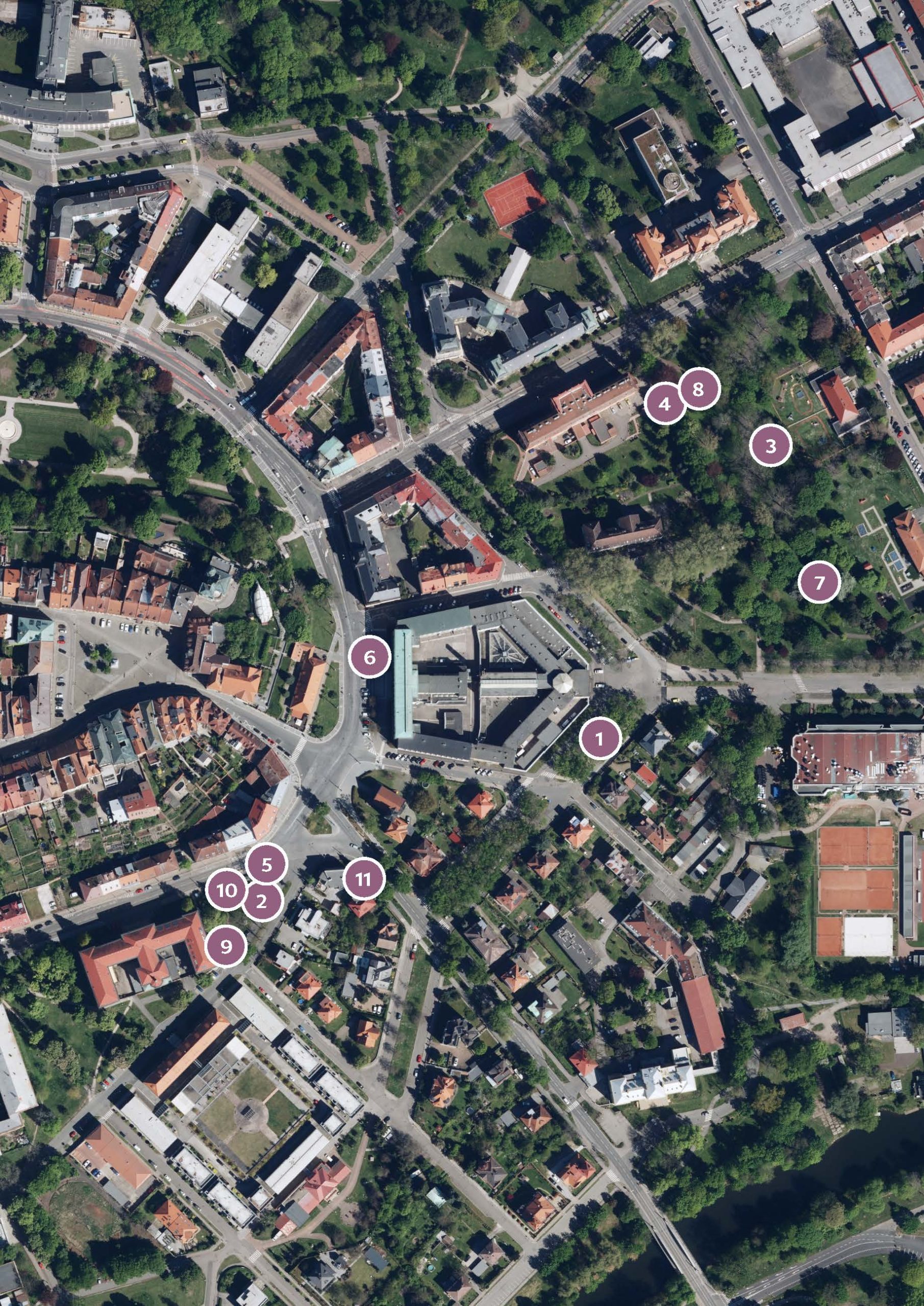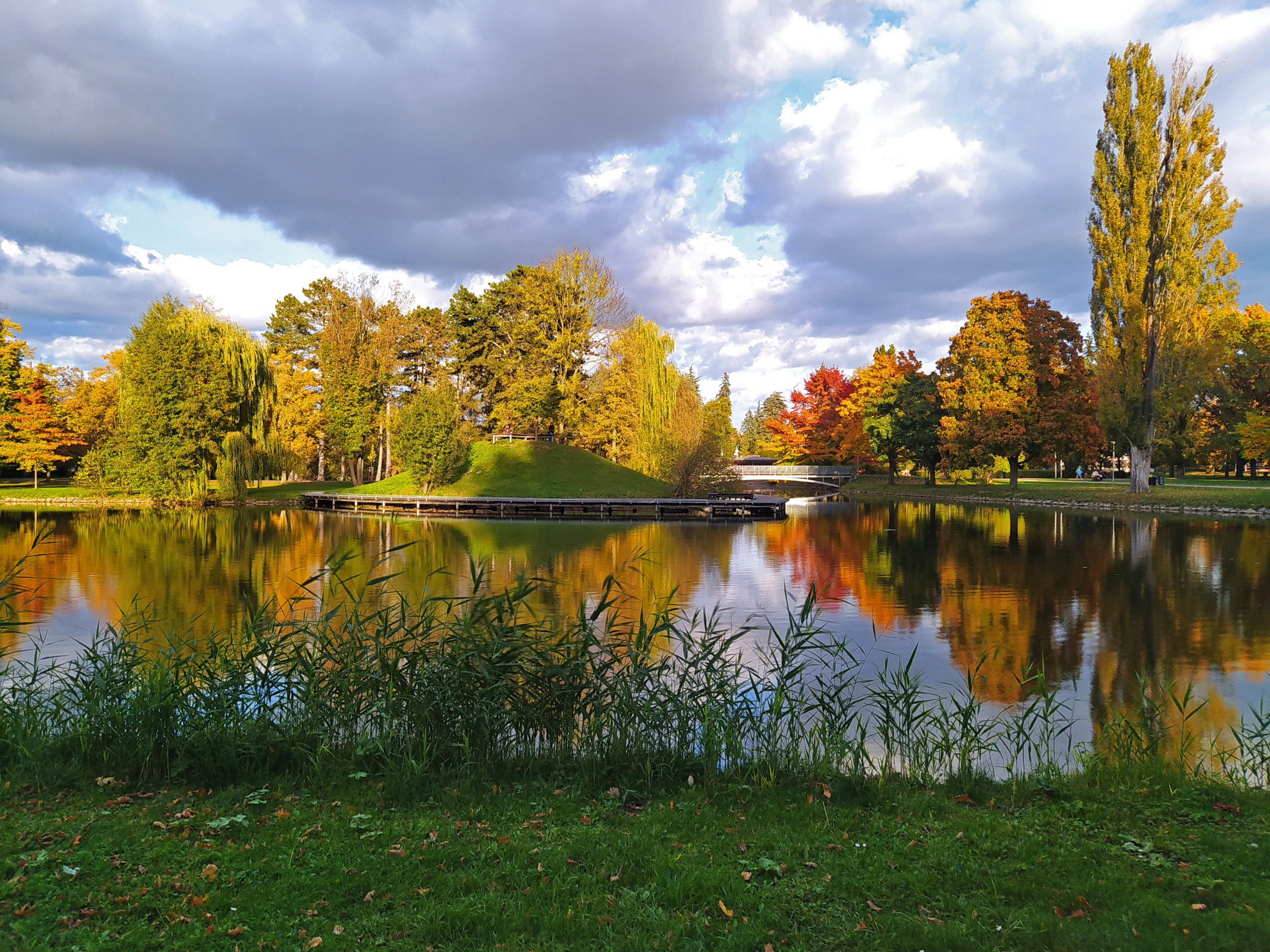

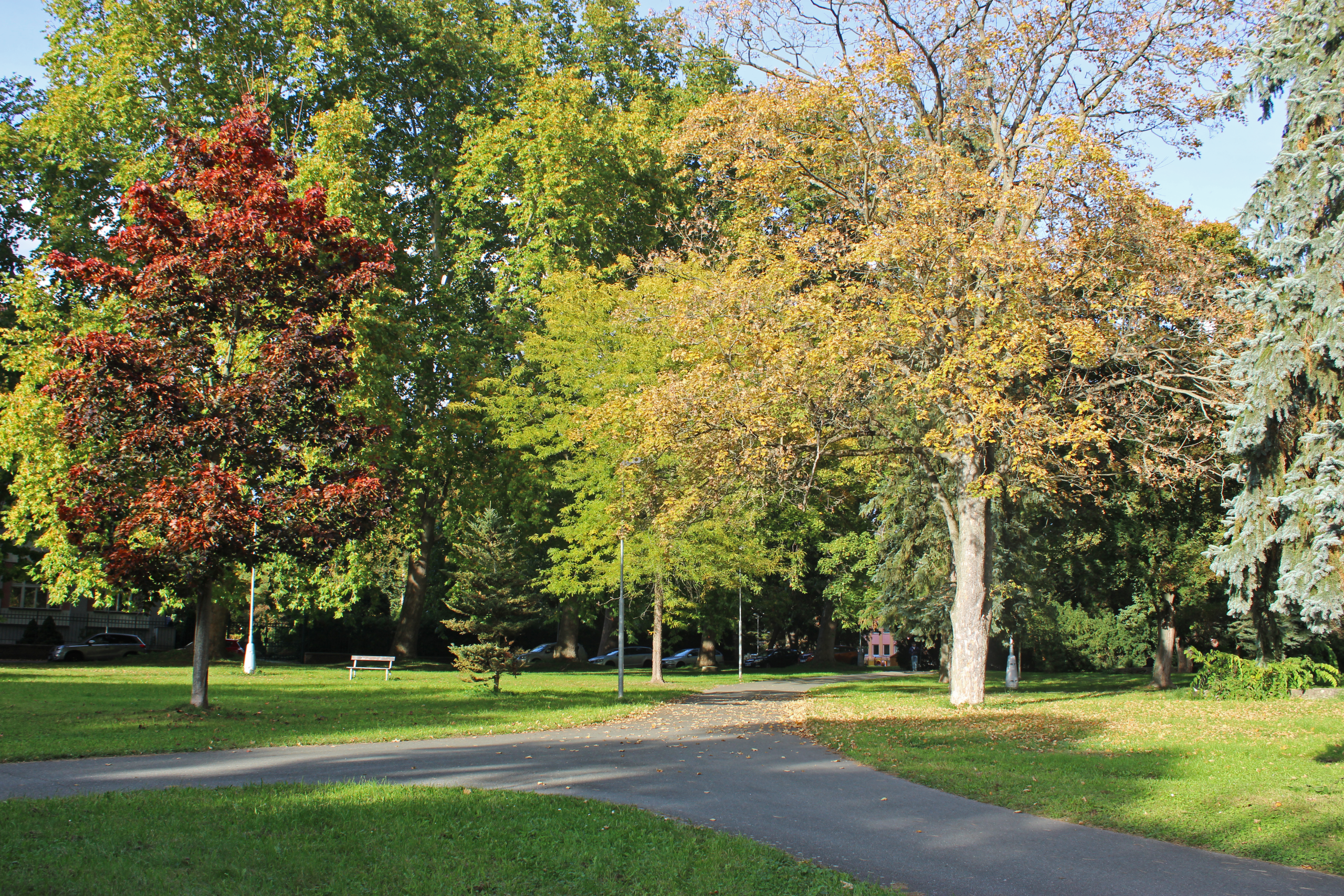
Kubišta´s Park is located between Pospíšil´s Street and Vít Nejedlý´s Street, in the area of the former fortress ramparts and the floodplain, in the vicinity of the Notre Dame School Sisters Convent and the former Institute for the Deaf-Mute.
Originally called Svatopluk Čech´s Park, this park was established in 1909. After the war, in 1946, it was renamed into Šverma´s Park. The current name of the park was introduced in 1992 to honour the cubist painter and graphic artist Bohumil Kubišta, who came from Vlčkovice near Hradec Králové. The creation of this park was associated also with the work of the Landscaping Guild.
At the time of the park´s establishment, the “Imperial Road” (called Silesian Road) which lined the moat on the eastern side of the floodplain ran through this area. The image of the “Imperial Road” is currently evoked by a path which is winding in an unusual way. The paths on the ramparts were probably planted with bordering alleys immediately after their creation. Unfortunately, the Prussian siege in 1866 was the reason that all the alleys around the city were cut down. This also applied to the alleys surrounding the Silesian Rampart, since they probably prevented an important view during the siege. In the 19th century, the surroundings of the paths and alleys themselves changed significantly. The alley along the Silesian Road was planted again after the war.
Around 1943, a W150 air raid shelter was established in the southern part of the park. It was made of reinforced concrete and was designed for 200 people. In the second half of the 20th century, a new pedestrian path was created in the southern part of the park, along the northern part of which an alley of catalpa trees was planted after 1971. Later, an alley of hornbeam trees was planted on the southern side. About 20 trees from the two-row alley have survived to this day.
Alley of Hackberry Trees behind the building of the Regional Justice Court in Hradec Králové
The building of the Regional Justice Court in Hradec Králové, located on the current Československé armády´s street, was built in 1930–1934 on the site of former fortress constructions. It forms a closed block with a pentagonal ground plan. It is divided into a judicial part and a prison part. The four-storey entrance section is attached to the lower side wings; in the middle there is a large court hall. The prison has an isosceles triangle ground plan, with three radially opened wings.
Along Hradební Street behind the Regional Justice Court building, there is a unique alley of Hackberry Trees. It is assumed that these trees were planted from the sources of the former Hacker´s tree nurseries, which were located on the outskirts of Hradec Králové. Rudolf Hacker was a prominent Czech entrepreneur, forester, grower, and inventor.
Park near the Vocational Medical School
In 1874, a high school was established in Hradec Králové (nowadays it is the secondary and upper secondary vocational medical school). To build the school, the site under the Silesian Gate, where there used to be a fenced section for storing cannonballs, was purchased. The purchased site was located along the road and reached the vicinity of Vodička´s Barracks. In 1886, the school was taken over by the state administration. During the war, the building was used as barracks, and in 1917–1918 it became an education institution again.
At the end of the 19th century, the school garden was converted into a fenced botanical garden. Until 1963, there were 13 species of rare trees in that place. Unfortunately, in 1966, the fence was removed and numerous rare trees were cut down.
1 – Hackberry (Celtis occidentalis)
2 – Cornelian Cherry (Cornus mas)
3 – Common Ash (Fraxinus excelsior)
4 – Norway Maple (Acer platanoides)
5 – Japanese Pagoda Tree (Sophora japonica)
6 – Indian Bean Tree (Catalpa bignonioides)
7 – Turkish Hazel (Corylus colurna)
8 – Goldenrain Tree (Koelreuteria paniculata)
9 – Cucumber Tree (Magnolia acuminata)
10 – Common Yew (Taxus baccata)
11 – Deerhorn Cedar (Thujopsis dolabrata)