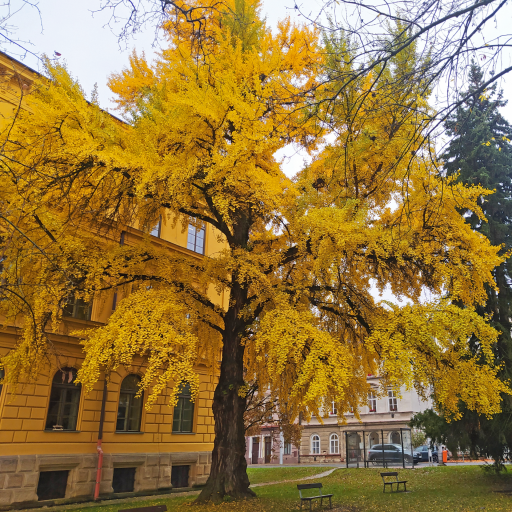

Ginkgo family, Ginkgoaceae
Origin: south-eastern China
Habitat in the original area: deciduous forests growing 1,100 metres above sea level
Habitus: A tree growing to the height of 40 metres; it has a spreading crown and horizontally standing branches. The bark is grey, smooth when young, furrowed when older.
Leaf: Petiolate leaves grow in bundles on brachyblasts, which can be up to 4 cm long. The leaf blade is wedge-shaped, mostly two-lobed with fan-shaped venation. In autumn it turns golden-yellow.
Bloom, fruit: This is a gymnosperm plant – neither are the eggs protected in the blossoms, nor are the seeds protected in the fruits. Male plants form cone-like structures similar to catkins, female ones form clusters of seeds on a thin stalk. The seeds are covered with a yellow covering. They resemble drupes.
Interesting fact: It is the only species from the Ginkgo family. It is dioecious – each individual has merely unisexual blossoms. Medicines that are obtained from the leaves stimulate blood circulation and thus improve blood flow.
A heritage tree:
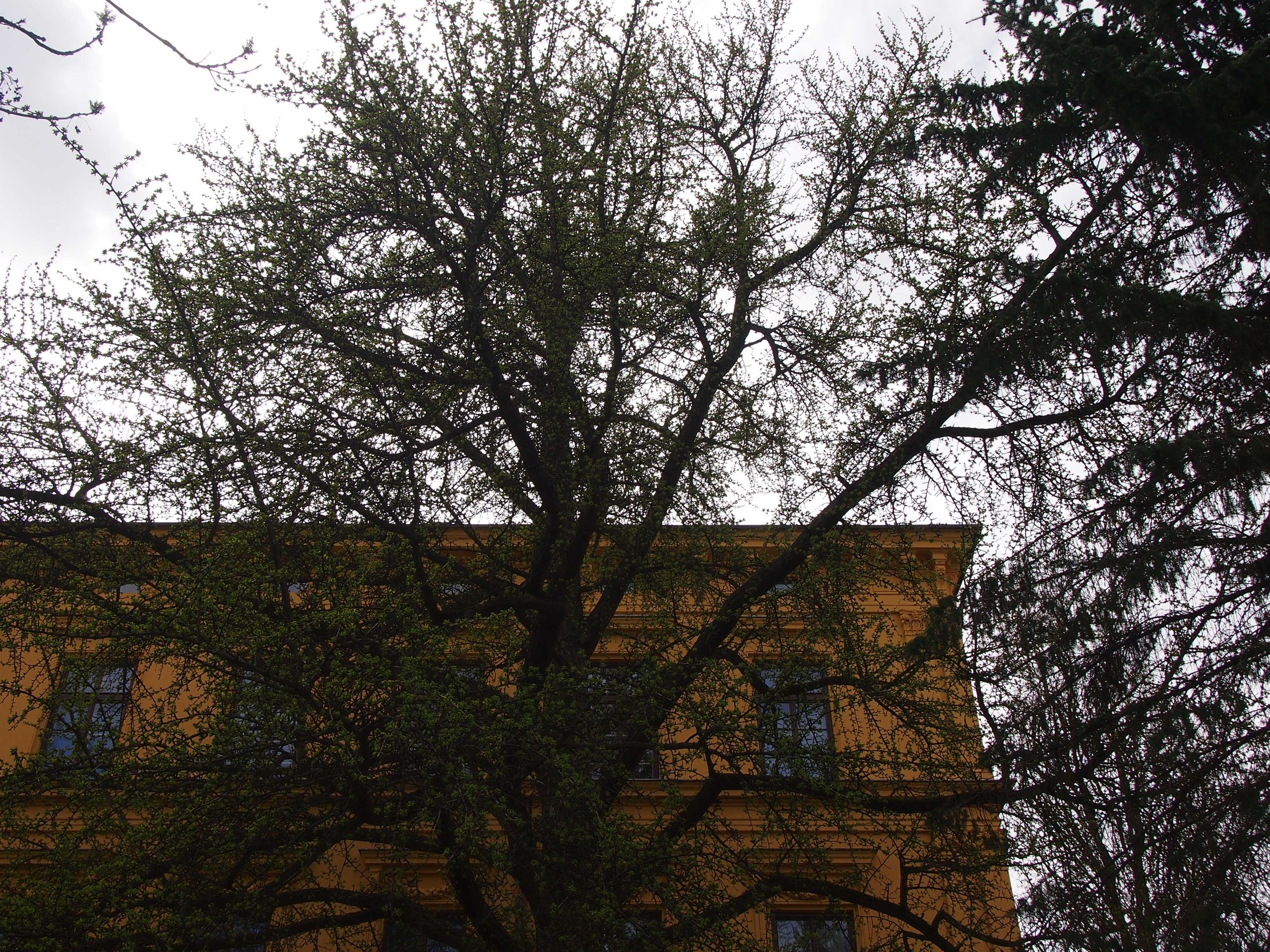
Ginkgo near the high medical school
Declared: 17. 12. 1994
Height: 22 m
Tree trunk´s circumference: 290 cm